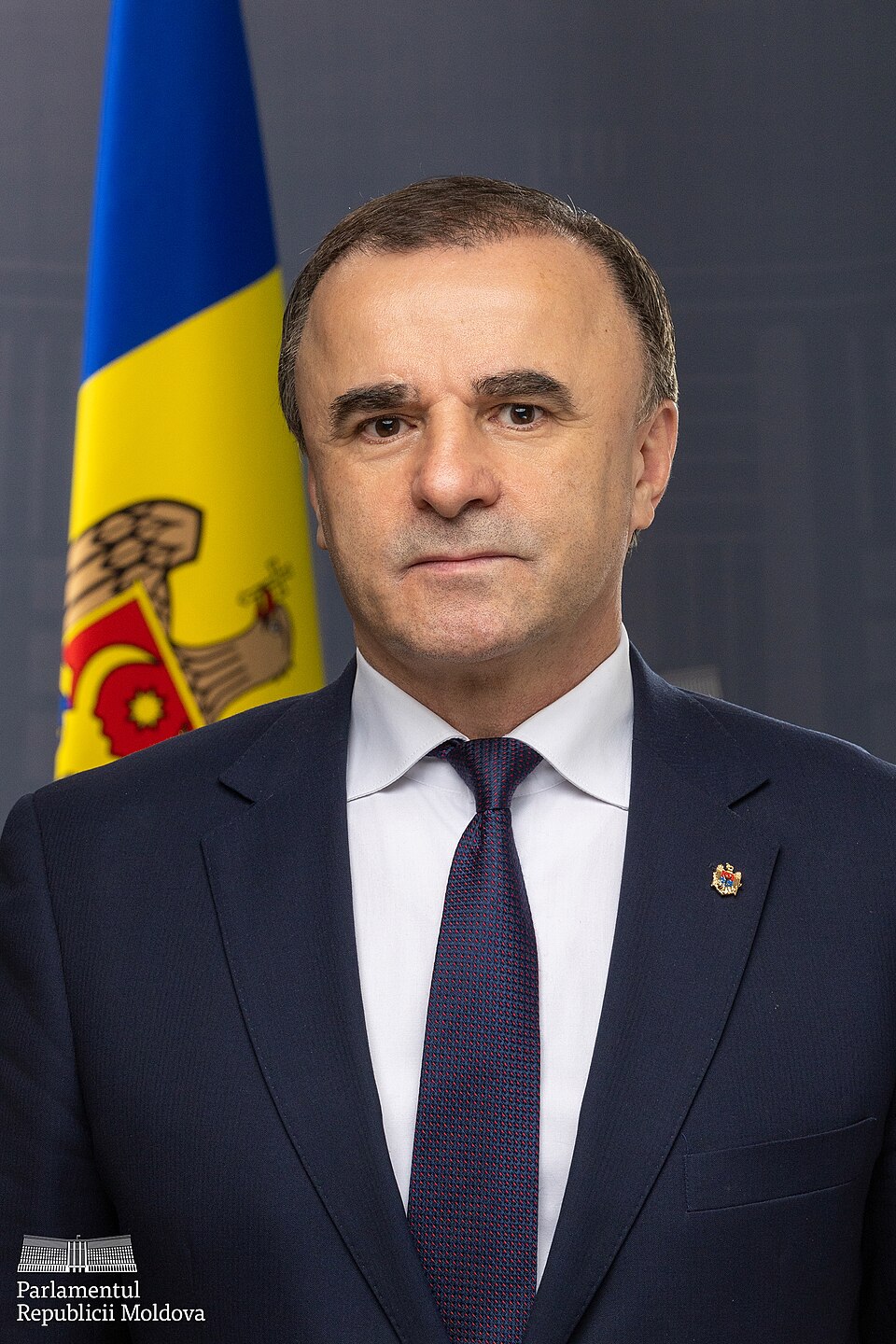

Prime Minister no. 6
Vasile Tarlev
Term ended- Cumulative time in office
- 2538 days
- PM affiliation
- Affiliation unresolved
The catalogue assigns PCRM throughout, while the biography states independent at appointment and PCRM from 2005. Classification by period needs confirmation.
- Born
- 6 October 1963, Bașcalia, raionul Basarabeasca, RSS Moldovenească
- Previous office
- Head of the Bucuria confectionery factory in Chișinău; member of economic councils attached to the state leadership
Cabinets
Not officially confirmed
The points below come from the press or encyclopedias and could not be checked against Parliament decisions, decrees or the Official Gazette.
- The investiture vote (75–11) is confirmed by RFE/RL, but the 19 April 2001 date comes only from Wikipedia; sources mention the oath on 20 April.
- President
- Vladimir Voronin
- Political backing
- PCRM parliamentary majority (largely technocratic cabinet)
- How the mandate began
- Nominated by presidential decree on 11 April 2001; Parliament approved the government by 75 votes to 11 (RFE/RL of 23 April 2001 confirms the tally and that the cabinet was sworn in on Friday, 20 April 2001). The vote date (19 April) comes from Wikipedia and is not confirmed by an official source.
- How it ended
- The cabinet's mandate ended after the 6 March 2005 election; Tarlev was reappointed and led a second cabinet.
- President
- Vladimir Voronin
- Political backing
- PCRM (56 seats)
- How the mandate began
- Nominated by President Voronin on 8 April 2005 (RFE/RL, 8 April 2005); on 19 April 2005 Parliament approved the government: 56 votes, all from Communist deputies out of 101, 21 against (Our Moldova Alliance), the other three opposition parties abstaining (RFE/RL, 19 April 2005).
- How it ended
- Tarlev resigned on 19 March 2008 at a cabinet session attended by Voronin, saying he wanted to make way for new people; the cabinet stayed on in an interim capacity until the Greceanîi government was invested on 31 March 2008. (the 19 March 2008 resignation is confirmed by Radio Free Europe, 23 March 2008).
Events
- 2001: invested on 19 April 2001 by 75 votes; the programme "Revival of the Economy - Revival of the Country" named the Transnistrian conflict, poverty and corruption as priorities.
- 2003: on 25 November Voronin refused to sign the Kozak Memorandum on a federal Moldovan state, hours before the ceremony planned with Putin.
- 2005: after the 6 March election he was reappointed on 19 April by 56 votes; programme "Modernising the Country - the People's Well-being".
- 2005: Moldova began implementing the EU-Moldova Action Plan under the European Neighbourhood Policy; the EU Delegation opened in Chișinău in October.
- 2006: in March Russia banned imports of Moldovan wine, hitting exports hard.
- 2008: he resigned on 19 March and handed over to Zinaida Greceanîi on 31 March.
Cabinet composition
Cabinet composition: Tarlev I Cabinet 21 members
| Name | Position |
|---|---|
| Vasile Tarlev | Prim-ministru |
| Vasile Iovv | Prim-viceprim-ministru |
| Valerian Cristea | Viceprim-ministru |
| Dmitrii Todoroglo | Viceprim-ministru, ministru al agriculturii și industriei alimentare |
| Andrei Stratan | Viceprim-ministru, ministru al afacerilor externe |
| Marian Lupu | Ministru al economiei |
| Mihail Garștea | Ministru al industriei |
| Vasile Zgardan | Ministru al transporturilor și comunicațiilor |
| Iacob Timciuc | Ministru al energeticii |
| Zinaida Greceanîi | Ministru al finanțelor |
| Valentin Beniuc | Ministru al educației |
| Veaceslav Madan | Ministru al culturii |
| Andrei Gherman | Ministru al sănătății |
| Constantin Mihailescu | Ministru al ecologiei și resurselor naturale |
| Valerian Revenco | Ministru al muncii și protecției sociale |
| Victoria Iftodi | Ministru al justiției |
| Gheorghe Papuc | Ministru al afacerilor interne |
| Valeriu Pleșca | Ministru al apărării |
| Vasilii Șova | Ministru al reintegrării Republicii Moldova |
| Gheorghe Tabunșcic | Guvernator al Găgăuziei |
| Gheorghe Duca | Președinte al Academiei de Științe a Moldovei |
Initial composition; later changes may be missing. Position titles are given in Romanian, as in the source. Source: alegeri.md (secondary source).
Cabinet composition: Tarlev II Cabinet 22 members
| Name | Position |
|---|---|
| Vasile Tarlev | Prim-ministru |
| Zinaida Greceanîi | Prim-viceprim-ministru |
| Victor Stepaniuc | Viceprim-ministru |
| Andrei Stratan | Viceprim-ministru, ministru al afacerilor externe și integrării europene |
| Igor Dodon | Ministru al economiei și comerțului |
| Mihail Pop | Ministru al finanțelor |
| Vladimir Antosii | Ministru al industriei și infrastructurii |
| Anatolie Gorodenco | Ministru al agriculturii și industriei alimentare |
| Vasile Ursu | Ministru al transporturilor și gospodăriei drumurilor |
| Violeta Ivanov | Ministru al ecologiei și resurselor naturale |
| Victor Țvircun | Ministru al educației și tineretului |
| Ion Ababii | Ministru al sănătății |
| Galina Balmoș | Ministru al protecției sociale, familiei și copilului |
| Artur Cozma | Ministru al culturii și turismului |
| Vitalie Pîrlog | Ministru al justiției |
| Gheorghe Papuc | Ministru al afacerilor interne |
| Vitalie Vrabie | Ministru al apărării |
| Vladimir Molojen | Ministru al dezvoltării informaționale |
| Vasilii Șova | Ministru al reintegrării |
| Valentin Guznac | Ministru al administrației publice locale |
| Mihail Formuzal | Guvernator al Găgăuziei |
| Gheorghe Duca | Președinte al Academiei de Științe a Moldovei |
Initial composition; later changes may be missing. Position titles are given in Romanian, as in the source. Source: alegeri.md (secondary source).
Education
He studied technology at the Serghei Lazo Polytechnic Institute in Chișinău (1985-1990), today the Technical University of Moldova.
Background
Party: Independent when appointed (2001); Party of Communists (PCRM) from 2005
Vasile Tarlev was born in 1963 in Bașcalia village, into a Bessarabian Bulgarian family. He graduated from the Polytechnic Institute in Chișinău and worked at the Bucuria confectionery factory, eventually becoming its head. In the late 1990s he sat on economic councils attached to the country's leadership.
In April 2001, after the Communists' first parliamentary election win since 1990, Vladimir Voronin put him forward as prime minister. He was 37, nominally independent, and his cabinet was largely technocratic. He went on to lead two consecutive governments and stayed in office for almost seven years, longer than any previous Moldovan prime minister.
His tenure was shaped by strained relations with Russia, a turn towards the EU after 2003 and Russia's 2006 embargo on Moldovan wine. He resigned in March 2008, publicly citing a wish to give way to new people, and was awarded the Order of the Republic.
After office
He led the Centrist Union of Moldova (2008-2009), withdrew from politics in November 2009, returned as co-chair of the Renaștere party (from 2012) and ran in the 2024 presidential election (sixth place, 3.19%).