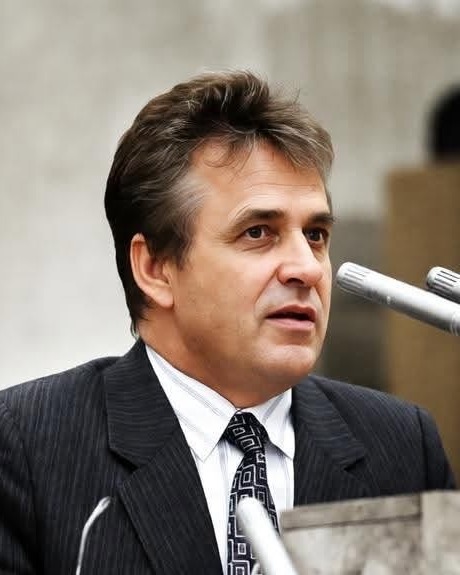
Prime Minister no. 0 · Pre-independence
Mircea Druc
Term ended- Term duration
- 368 days
- PM affiliation
- Popular Front
- Born
- 25 July 1941, Pociumbăuți, raionul Rîșcani, Moldova
- Previous office
- Deputy in the Supreme Soviet of the Moldavian SSR (Popular Front), elected 1990
The Druc Government served before independence was declared (27 August 1991), during the struggle for independence. It is therefore numbered 0, outside the numbering of the independent state’s prime ministers, and is not included in the statistics.
Cabinet
Not officially confirmed
The points below come from the press or encyclopedias and could not be checked against Parliament decisions, decrees or the Official Gazette.
- End of the mandate: 28 May 1991 (ro.wikipedia, alegeri.md) or 22 May 1991 (en.wikipedia), probably when the government became a caretaker. The vote count of the no-confidence motion was not found.
- Start of the mandate: elected prime minister on 25 May 1990; the cabinet’s confidence vote is dated 24 May (Wikipedia). Dates come from secondary sources, not from the Supreme Soviet’s decision.
- His birthplace (Pociumbăuți) and some biographical details differ between the ro.wikipedia infobox and text. The photo comes from the National Archives Agency (Mihai Potârniche collection), where he is identified as Mircea Druc.
- President
- Mircea Snegur (președintele Sovietului Suprem; din 3 septembrie 1990, președinte al RSS Moldova, numit de Sovietul Suprem)
- Political backing
- Backed by the Popular Front parliamentary group, which won the 1990 elections; the first cabinet in Soviet Moldova led by someone from the anti-communist movement rather than the CPSU.
- How the mandate began
- The newly elected Supreme Soviet considered the government on 24 May 1990: the cabinet received 259 votes in favour and one abstention, and Mircea Druc, put forward by Supreme Soviet chairman Mircea Snegur, was elected prime minister on 25 May 1990.
- How it ended
- Parliament passed a no-confidence vote (initiated by deputy Nicolae Andronic); the government ceased full powers on 22 May 1991 and Druc was dismissed by President Snegur on 28 May 1991, when Valeriu Muravschi was named prime minister. The vote count was not found.
Events
- 24–25 May 1990: the Supreme Soviet gives the cabinet its confidence (259 votes for, one abstention) and elects Druc prime minister; many ministers are appointed in early June.
- 23 June 1990: Parliament adopts the Declaration of Sovereignty, asserting the supremacy of the republic's laws over Union laws.
- August 1990: a Gagauz republic is declared in Comrat; on 2 September 1990 a Transnistrian Moldavian SSR is proclaimed in Tiraspol, and Parliament declares both acts null.
- 3 September 1990: the Supreme Soviet appoints Mircea Snegur president of the Moldavian SSR.
- 1990–1991: the government sets up the first structures of a national army, national police, carabinieri-type troops and special services; Romanian becomes the language of instruction in schools and universities.
- 1990–1991: privatisation is delayed until the National Bank and citizenship laws are adopted; over 3,000 pupils and students are sent to study in Romania and elsewhere.
- 20 May 1991: the Ministry of Foreign Relations is renamed Ministry of Foreign Affairs (Supreme Soviet decision no. 583).
- 23 May 1991: the state's official name changes from Moldavian SSR to Republic of Moldova; 28 May 1991: Druc is dismissed and Valeriu Muravschi is named prime minister.
Cabinet composition
Cabinet composition: Druc Cabinet 20 members
| Name | Position | Since |
|---|---|---|
| Mircea Druc | Prim-ministru | 25 May 1990 |
| Andrei Sangheli | Prim-viceprim-ministru, ministru al agriculturii și alimentației | 29 May 1990 |
| Constantin Oboroc | Prim-viceprim-ministru | 5 June 1990 |
| Gheorghe Gaindric | Ministru de stat | 23 June 1990 |
| Constantin Tampiza | Viceprim-ministru, ministru al economiei naționale | 5 June 1990 |
| Dmitrii Leașenco | Ministru al industriei și energeticii | 15 June 1990 |
| Gheorghe Călugăru | Ministru al construcțiilor | 15 June 1990 |
| Constantin Iavorschi | Ministru al resurselor materiale | 5 June 1990 |
| Valerii Kozlov | Ministru al transporturilor | 19 June 1990 |
| Valeriu Bobuțac | Ministru al comerțului | 5 June 1990 |
| Valeriu Muravschi | Ministru al finanțelor | 19 June 1990 |
| Timofei Andros | Ministru al informaticii, informației și telecomunicațiilor | 5 June 1990 |
| Gheorghe Ghidirim | Ministru al sănătății | 5 June 1990 |
| Ion Ungureanu | Ministru al culturii și cultelor | 5 June 1990 |
| Nicolae Mătcaș | Ministru al științei și învățământului | 5 June 1990 |
| Alexei Barbăneagră | Ministru al justiției | 6 June 1990 |
| Ion Costaș | Ministru al afacerilor interne | 13 June 1990 |
| Gheorghe Spinei | Ministru al muncii și protecției sociale | 5 June 1990 |
| Nicolae Țâu | Ministru al afacerilor externe[1] | 5 June 1990 |
| Tudor Botnari | Președinte al Comitetului pentru securitatea statului | 23 June 1990 |
On small screens, scroll the table horizontally to see all columns.Initial composition; later changes may be missing. Position titles are given in Romanian, as in the source. Source: alegeri.md (secondary source).
Education
He studied at Chișinău State University and Leningrad University (Romance languages), and earned a doctorate in economics in Moscow.
Background
Party: Popular Front of Moldova (during his term); later independent and a member of several Romanian parties
Mircea Druc was born on 25 July 1941 in Pociumbăuți into a peasant family. He studied in Chișinău, Leningrad and Moscow, then taught administrative sciences at the Chișinău Polytechnic Institute. He was expelled from the CPSU in 1972 and later worked as a researcher in Moscow and Chernivtsi, where in 1988 he became vice-president of the Mihai Eminescu cultural society.
In 1990, after the first partly free elections in the Moldavian SSR, he was elected a deputy for the Popular Front, and on 25 May 1990 the Supreme Soviet elected him prime minister. His government served in the year of the Declaration of Sovereignty and of the first clashes with the separatist regions in the east and south.
Druc was removed in May 1991, before independence was proclaimed on 27 August 1991. He could not run in the December 1991 presidential election, settled in Romania and in 1992 ran for the Romanian presidency, winning 2.75%.
After office
He could not run in the December 1991 presidential election because of a residency requirement. In 1992 he led the Christian-Democratic Popular Front and the National Council of Reunification, regained Romanian citizenship (6 July 1992) and ran as an independent in the Romanian presidential election (27 September 1992, 2.75%). He later held the post of adviser to the President of the Chamber of Commerce and Industry of Romania (CCIR), ran unsuccessfully for the PDL in 2008 and received the Order of the Star of Romania (2014). He is living.