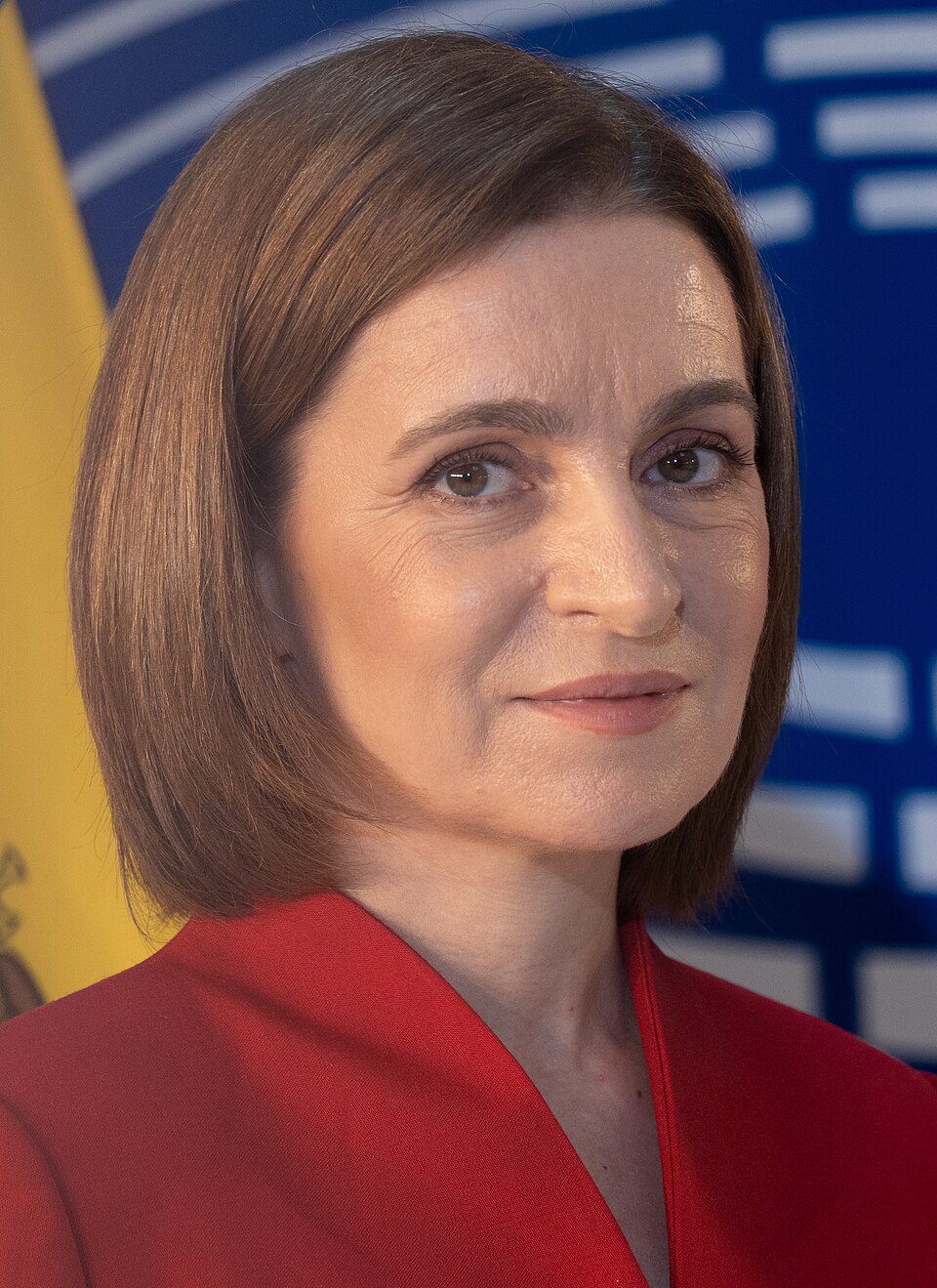

Prime Minister no. 13
Maia Sandu
Term ended- Term duration
- 159 days · Transfer of power
- PM affiliation
- Party of Action and Solidarity
- Born
- 24 May 1972, Risipeni, raionul Fălești
- Previous office
- MP (ACUM bloc); former Minister of Education (2012–2015)
Cabinet
Not officially confirmed
The points below come from the press or encyclopedias and could not be checked against Parliament decisions, decrees or the Official Gazette.
- The mandate starts on 8 June 2019 (the Parliament vote); the government was effectively recognised only on 14–15 June 2019, after the Constitutional Court’s rulings. The official texts of the rulings were not consulted.
Legal succession on 8 June 2019: the Filip government’s term ends on the day the Sandu government was invested, with no gap between terms (0 days). The effective transfer of power was nevertheless blocked for six days, from 8 to 14 June 2019. On 14 June Filip announced his withdrawal from government and the transfer of power; on 15 June the Constitutional Court annulled its acts of 7–9 June. The six days describe the institutional transition, not overlapping legal terms.
- President
- Igor Dodon
- Political backing
- Temporary coalition of the ACUM bloc (PAS and Platforma DA) and the PSRM
- How the mandate began
- Elected prime minister by Parliament on 8 June 2019 with 61 of 101 votes (PAS, Platforma DA and PSRM; PDM deputies boycotted the session), on the nomination of President Igor Dodon; Dodon signed the decrees and the cabinet was sworn in the same day. The Constitutional Court later declared the acts illegal, and the government gained full recognition only after the Filip government resigned (14 June) and the Court repealed its rulings (15 June).
- How it ended
- Dismissed by a no-confidence motion on 12 November 2019 with 63 votes (34 PSRM and 29 PDM), after the government took responsibility for amendments to the Law on the Prosecutor's Office; the Chicu government was invested on 14 November.
Events
- 8 June 2019: Parliament elects Sandu prime minister with 61 votes.
- 7 June 2019 (evening): the Constitutional Court, which the PDM controlled, declares that the three-month deadline to form a government has expired and that Parliament's actions are illegal.
- 8 June 2019: PSRM and ACUM elect Zinaida Greceanîi Speaker, Dodon names Sandu, and the government is voted (61 votes) and sworn in; the Court later declares the acts unconstitutional.
- 9 June 2019: the Court suspends Dodon from office and Pavel Filip, as interim president, signs the decree dissolving Parliament (elections on 6 September); the EU says it is ready to work with the "democratically legitimate" government.
- 14-15 June 2019: the Filip government resigns (14 June) and on 15 June the Court repeals all its 7-9 June rulings; the Sandu government takes full power and holds its first meeting.
- 2019: the government lifts the 2017 ban on official visits to Russia.
- September 2019: Sandu meets US Vice President Mike Pence in Washington.
- 2019: she asks the US Treasury to add Vlad Plahotniuc to the Magnitsky list and proposes 23 August as a European Day of Remembrance for Victims of Stalinism and Nazism, opposed by the PSRM.
- 12 November 2019: the government is dismissed by a no-confidence motion (63 votes).
Cabinet composition
Cabinet composition: Sandu Cabinet 12 members
| Name | Position | Party |
|---|---|---|
| Maia Sandu | Prim-ministru | PAS |
| Andrei Năstase | Viceprim-ministru, ministru al afacerilor interne | PPPDA |
| Vasilii Șova | Viceprim-ministru pentru reintegrare | |
| Vadim Brînzan | Ministru al economiei și infrastructurii | |
| Natalia Gavrilița | Ministru al finanțelor | PAS |
| Stanislav Pavlovschi | Ministru al justiției | PPPDA |
| Nicu Popescu | Ministru al afacerilor externe și integrării europene | |
| Pavel Voicu | Ministru al apărării | |
| Georgeta Mincu | Ministru al agriculturii, dezvoltării regionale și mediului | |
| Liliana Nicolaescu-Onofrei | Ministru al educației, culturii și cercetării | PAS |
| Ala Nemerenco | Ministru al sănătății, muncii și protecției sociale | |
| Irina Vlah | Guvernator al Găgăuziei |
Initial composition; later changes may be missing. Position titles are given in Romanian, as in the source. Source: alegeri.md (secondary source).
Education
ASEM (business management), the Academy of Public Administration (master's in international affairs) and Harvard Kennedy School (master's in public policy, 2010).
Background
Party: Party of Action and Solidarity (PAS), founder and leader (2016–2020); later independent
Maia Sandu was born in 1972 in Risipeni. She studied at ASEM and the Academy of Public Administration, then earned a master's in public policy at the Harvard Kennedy School (2010). She was an adviser to the World Bank's executive director (2010–2012) and Minister of Education (2012–2015).
In 2016 she founded the Party of Action and Solidarity. After the 24 February 2019 parliamentary elections, the ACUM bloc she belonged to negotiated a government with the PSRM, and on 8 June 2019 Parliament elected her prime minister with 61 votes.
She led a cabinet built on an unusual coalition of ACUM and the Socialists, formed amid a constitutional crisis in which the Constitutional Court issued contradictory rulings. The mandate lasted five months and ended on 12 November 2019 with the PSRM's no-confidence motion, also supported by the PDM.
After office
After her dismissal she stayed in opposition; she won the 15 November 2020 presidential runoff (57.72% to Igor Dodon's 42.28%, per Interfax) and was sworn in as President on 24 December 2020.