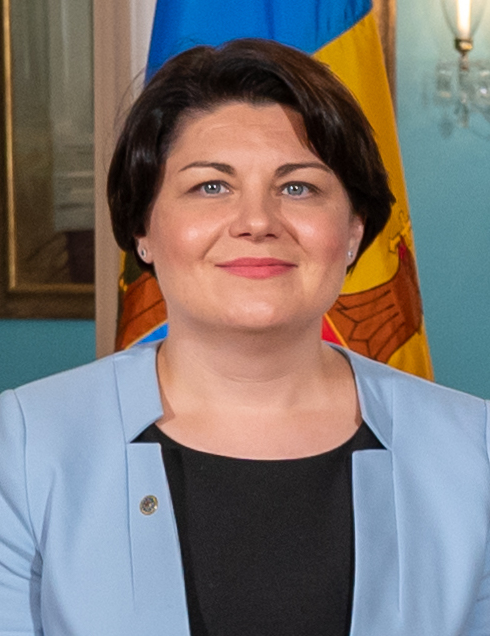

Prime Minister no. 15
Natalia Gavrilița
Term ended- Term duration
- 559 days
- PM affiliation
- Party of Action and Solidarity
- Born
- 21 September 1977, Mălăiești, raionul Grigoriopol, RSS Moldovenească
- Previous office
- Minister of Finance (June - November 2019); member of Parliament
Cabinet
Not officially confirmed
The points below come from the press or encyclopedias and could not be checked against Parliament decisions, decrees or the Official Gazette.
- Her activity after leaving office could not be verified.
- The cabinet list comes from gov.md (old archive) and Wikipedia; the official decision text was not opened. The Culture minister’s name (Sergiu Prodan) is confirmed only by Wikipedia.
- President
- Maia Sandu
- Political backing
- Single-party PAS government (63-seat majority) with many independent ministers.
- How the mandate began
- Invested by Parliament on 6 August 2021 along with her ministers and the programme "Moldova of good times", with 61 of 101 votes. An earlier nomination in February 2021 had been rejected by the PSRM-Șor majority.
- How it ended
- She announced her resignation on 10 February 2023; Maia Sandu took note of it the same day and signed the decree designating Dorin Recean; her resignation brought down the whole cabinet. Gavrilița said the government had worked in "continuous crisis" and that reforms would have advanced faster with the same support at home as from the EU. The government's powers ended on 16 February 2023 with the investiture and oath of the Recean cabinet.
Events
- 6 August 2021: invested with 61 votes; the 45-page programme "Moldova of good times" is approved together with the ministers' list.
- 22 October 2021: gas crisis with Gazprom; a 30-day state of emergency in the energy sector.
- Late October 2021: Deputy PM Andrei Spînu concludes a new five-year contract with Gazprom.
- January 2022: Gazprom demands an advance of about 63 million dollars, paid from the state budget; the government again seeks an energy state of emergency.
- March 2022: Moldova submits its formal application for EU membership.
- June 2022: Moldova is granted EU candidate status.
- 10 February 2023: Gavrilița resigns and Maia Sandu nominates Dorin Recean as prime minister.
Cabinet composition
Cabinet composition: Gavrilița Cabinet 16 members
| Name | Position | Party |
|---|---|---|
| Natalia Gavrilița | Prim-ministră | PAS |
| Nicu Popescu | Viceprim-ministru, ministru al afacerilor externe și integrării europene | |
| Andrei Spînu | Viceprim-ministru, ministru al infrastructurii și dezvoltării regionale | PAS |
| Vladislav Kulminski | Viceprim-ministru pentru reintegrare | |
| Iurie Țurcanu | Viceprim-ministru pentru digitalizare | |
| Ana Revenco | Ministra afacerilor interne | |
| Viorel Gherciu | Ministrul agriculturii și industriei alimentare | |
| Anatolie Nosatîi | Ministrul apărării | |
| Sergiu Prodan | Ministrul culturii | |
| Sergiu Gaibu | Ministrul economiei | |
| Dumitru Budianschi | Ministrul finanțelor | PAS |
| Anatolie Topală | Ministrul educației și cercetării | |
| Sergiu Litvinenco | Ministrul justiției | |
| Iuliana Cantaragiu | Ministra mediului | |
| Marcel Spătari | Ministrul muncii și protecției sociale | |
| Ala Nemerenco | Ministra sănătății |
Initial composition; later changes may be missing. Position titles are given in Romanian, as in the source. Source: gov.md, TRM.
Education
Degree in international law from Moldova State University (2000), Muskie fellow (2003) and a master's in public policy from Harvard's Kennedy School.
Background
Party: Party of Action and Solidarity (PAS), vice-president
Natalia Gavrilița (née Catrinescu) was born on 21 September 1977 in Mălăiești. She studied international law in Chișinău and public policy at Harvard. She worked in the Ministry of Economy and Trade and the State Chancellery, then for Oxford Policy Management in the United Kingdom.
From 2013 to 2015 she was state secretary and chief of staff at the Ministry of Education under Maia Sandu, and executive director of a World Bank project. From 2015 to 2019 she led the Global Innovation Fund. In 2019 she was finance minister in the Sandu government, where she drafted the so-called Solidarity Budget.
After the 11 July 2021 elections won by PAS, she was invested as prime minister on 6 August 2021. Her cabinet, largely made up of independents, was often called a government of crises: the autumn 2021 gas crisis, the war in Ukraine and an energy and economic squeeze. Under her government Moldova applied for EU membership. She resigned on 10 February 2023.
After office
I could not verify what role she took after leaving the government; the sources consulted only list her as PAS vice-president and an MP in the 11th legislature.